Interview Preparation
STAR and START Interview Methods: Complete Guide with Examples
The STAR method is a structure for answering behavioral interview questions with evidence from a specific experience. STAR stands for Situation, Task, Action, and Result. The START method adds a final Takeaway: one sentence about what you learned or how the experience prepares you for the job.
Use the framework like this:
When [situation], I needed to [task]. I [actions and decisions]. As a result, [outcome and evidence]. The takeaway I would bring to this role is [lesson or future application].
Keep the context short, make your individual contribution unmistakable, and finish with a result you can defend. Never invent numbers or present a fictional example as your own.
Editorial standard: This guide distinguishes the traditional STAR method from the START variation. Definitions and preparation guidance were checked against the U.S. Department of Labor, MIT Career Advising, the University of Nebraska–Lincoln, Yale career services, and Amazon's candidate guidance. Sources were reviewed July 12, 2026. The sample answers are fictional teaching examples; replace every detail with your own facts.
STAR and START at a Glance
| Part | What the interviewer needs | Questions to answer | Useful length |
|---|---|---|---|
| S — Situation | Enough context to understand the stakes | Where and when? What was happening? Who was affected? | 1–2 sentences |
| T — Task | Your responsibility, target, or constraint | What were you accountable for? What made it difficult? | 1 sentence |
| A — Action | Your judgment and personal contribution | What did you do, how, and why? What changed along the way? | 3–5 sentences |
| R — Result | The outcome and evidence | What improved? What did you deliver, prevent, or learn? | 1–2 sentences |
| T — Takeaway | Reflection and relevance to the new role | What will you repeat, change, or apply here? | 1 sentence |
MIT's STAR guidance suggests a 20% Situation, 10% Task, 60% Action, and 10% Result split as a flexible practice aid—not a scoring rule. The central lesson is sound: most of your answer should explain the actions you personally took.
What Is the STAR Method?
STAR is a four-part narrative structure:
- Situation: Set the scene with a specific event, not a general description of how you usually work.
- Task: State the goal, problem, responsibility, or constraint that belonged to you.
- Action: Explain the steps you personally took, the choices you made, and why.
- Result: Show what happened, who benefited, and what you learned.
The method is best suited to behavioral or competency-based questions that ask for past evidence:
- “Tell me about a time you resolved a conflict.”
- “Give me an example of a difficult decision.”
- “Describe a situation where you had to adapt quickly.”
- “What is an achievement you are proud of?”
The U.S. Department of Labor's 2026 Interview Skills guide describes STAR as a four-step technique for showing how you used skills to achieve goals and recommends evidence, specific examples, data, and numbers where applicable. Amazon's candidate guidance likewise asks candidates to use STAR for behavioral questions in its interview process.
STAR is not a script and it does not make an example strong by itself. The evidence still has to be relevant, truthful, and specific.
What Is the START Method?
START means Situation, Task, Action, Result, Takeaway. The first four steps are identical to STAR. The extra Takeaway answers one of these questions:
- What did you learn?
- What would you repeat or change next time?
- How has the experience changed the way you work?
- How does the lesson relate to this job?
The University of Nebraska–Lincoln's START method explicitly defines the final T as a takeaway connected to the position.
STAR vs. START: which should you use?
| Use STAR when… | Add the START takeaway when… |
|---|---|
| The result already makes your relevance obvious | The lesson needs to be connected to the target job |
| The interviewer wants a concise example | The question asks what you learned or would do differently |
| You have a clear, positive outcome | The outcome was mixed, negative, or still developing |
| Time is limited | Reflection is part of the competency being assessed |
You do not need to announce, “Now for my takeaway.” One natural sentence is enough: “That experience taught me to confirm ownership before work begins, and I now use the same check at every project kickoff.”
The Best STAR Answer Formula
Use this five-line outline before you practice aloud:
Situation: During [specific event or context], [relevant challenge or stakes].
Task: I was responsible for [goal, decision, or constraint].
Action: I [step 1], [step 2], and [step 3], because [reasoning].
Result: This led to [verified outcome, evidence, or lesson].
Takeaway (optional): I learned [lesson], which I would apply here by [relevance].
A useful spoken answer often takes 60 to 120 seconds. Treat that as a rehearsal range, not a law. A complex leadership example may need longer; a straightforward service recovery may need less. If the interviewer asks a follow-up, answer it directly instead of restarting the whole framework.
A complete START answer, annotated
Question: “Tell me about a time you improved an inefficient process.”
Situation: “At a subscription software company, our support team manually copied recurring product issues into a weekly spreadsheet, and reports were often two days late.”
Task: “As the support operations analyst, I was responsible for making the report reliable without changing the ticketing platform.”
Action: “I interviewed the three people who built the report, mapped the duplicate steps, and created a saved ticket view with consistent issue tags. I then built an automated export, tested it against four prior reports, documented the exceptions, and trained the team in a 30-minute session.”
Result: “Preparation time fell from about four hours to 45 minutes, the next six reports went out on schedule, and the product team used the cleaner categories to prioritize two fixes.”
Takeaway: “I learned to validate a process with the people doing the work before automating it, and I would use that same approach when improving workflows here.”
Why it works: the answer names a concrete problem, isolates the candidate's responsibility, explains actions and reasoning, provides credible evidence, and connects the lesson to future work.
How to Build STAR Stories Before an Interview
1. Extract the competencies from the job description
Highlight the skills and behaviors the employer will probably test: leadership, collaboration, customer judgment, analysis, prioritization, adaptability, communication, technical depth, or ownership. Separate required evidence from generic adjectives.
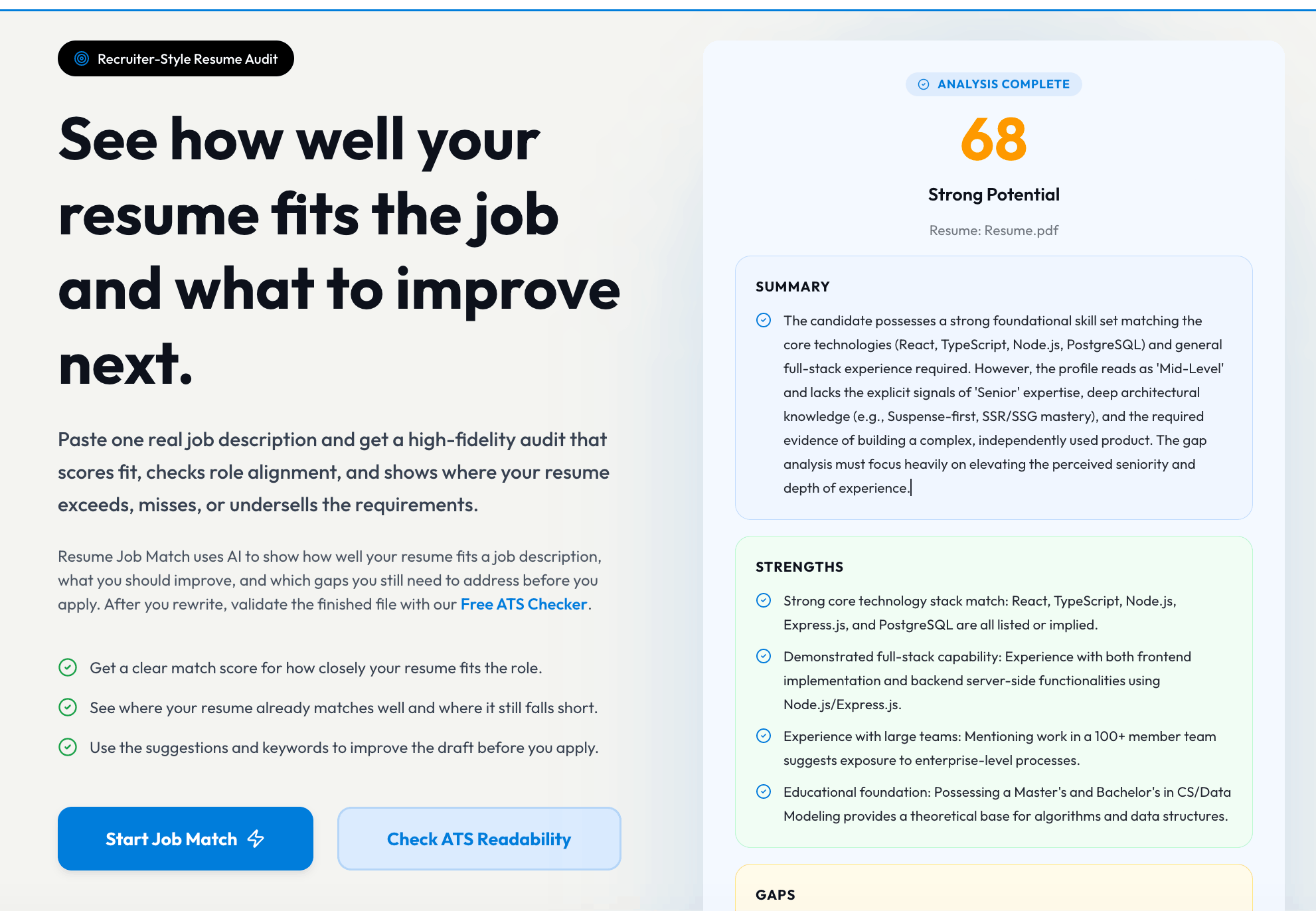
For a faster workflow, compare the posting with your experience using the resume job match tool, then turn the strongest proof into interview stories.
2. Create a story bank, not a script bank
Prepare six to eight experiences that collectively cover:
- A meaningful achievement
- A difficult problem or ambiguous decision
- Teamwork or influence without authority
- Conflict or difficult feedback
- A tight deadline or competing priorities
- A mistake, failure, or lesson
- Initiative or process improvement
- Change, uncertainty, or rapid learning
One story can demonstrate several competencies, but do not force the same story into every question. Interviewers in a panel may compare notes.
3. Write bullet prompts instead of memorizing paragraphs
Record only the anchors you need:
- Situation: quarter-end reporting; teammate absent; 48-hour deadline
- Task: deliver accurate forecast; no extra budget
- Action: narrowed scope; validated data; reassigned review; updated stakeholders
- Result: submitted on time; one error caught; process reused
- Takeaway: communicate tradeoffs early
MIT Career Advising recommends preparing a small set of stories with a bulleted outline and warns that word-for-word memorization can make answers less adaptable and natural.
4. Verify every detail
Check dates, team size, scope, tools, and results against what you can honestly defend. If you do not know an exact number, use an accurate range, a clearly labeled approximation, or a qualitative result. Never manufacture a metric to make the story sound impressive.
5. Practice the answer and the follow-ups
Say the answer aloud, then practice:
- “Why did you choose that approach?”
- “What was your personal contribution?”
- “What resistance did you face?”
- “What would you do differently?”
- “How did you measure the result?”
The goal is not perfect wording. It is quick recall, clear reasoning, and comfort when the interviewer probes beyond your first answer. Use the AI mock interview tool to generate questions from a target job and practice follow-ups.
Common STAR Interview Questions by Competency
Leadership and ownership
- Tell me about a time you led without formal authority.
- Describe a decision you made with incomplete information.
- Give me an example of when you took responsibility for a problem.
- Tell me about a time you had to align people with different priorities.
Teamwork, conflict, and communication
- Tell me about a conflict with a colleague or stakeholder.
- Describe a time you changed someone's mind.
- Give me an example of receiving difficult feedback.
- Tell me about a time you explained something complex to a non-expert.
Problem-solving and judgment
- Describe the most difficult problem you solved recently.
- Tell me about a time the obvious solution did not work.
- Give me an example of using data to make a decision.
- Tell me about a risk you identified before others did.
Prioritization and adaptability
- Tell me about a time you managed competing deadlines.
- Describe a situation where requirements changed suddenly.
- Give me an example of working effectively under pressure.
- Tell me about a time you had to learn something quickly.
Failure, growth, and resilience
- Tell me about a mistake you made.
- Describe a goal you did not achieve.
- Give me an example of a project that went off track.
- Tell me about a time you would handle differently now.
The same question can test more than one competency. Listen for the exact wording, choose the closest relevant example, and answer the question that was actually asked.
STAR Method Examples by Role
The examples below are fictional models. Their metrics illustrate the level of specificity that helps; do not copy a number, tool, or result unless it is true for you.
Software engineer: production incident
Question: “Tell me about a time you solved a critical technical problem.”
Situation/Task: During a product launch, checkout errors rose after a service deployment. As the engineer on call, I needed to restore successful transactions and preserve evidence for diagnosis.
Action: I checked the deployment diff and traces, isolated failures to a new timeout setting, and rolled back that configuration rather than the full release. I opened an incident channel, assigned one teammate to validate recovery, updated customer support every 15 minutes, and later added a load test for the failure mode.
Result/Takeaway: Successful checkouts returned to baseline within 22 minutes, and the new test caught the same configuration issue before the next release. I learned to separate immediate recovery from root-cause work and communicate both tracks clearly.
Project manager: competing priorities
Question: “Describe a time you managed conflicting stakeholder demands.”
Situation/Task: Two department heads requested urgent features from the same delivery team, but the sprint had capacity for only one. I was accountable for recommending a plan and protecting the release date.
Action: I documented each request's user impact, dependency risk, and deadline, then facilitated a 30-minute tradeoff meeting. I proposed delivering the compliance-critical feature first and a manual workaround for the second request, with a scheduled date for full delivery.
Result/Takeaway: Both leaders approved the sequence, the release shipped on time, and the workaround supported the second team for three weeks. The experience reinforced that visible decision criteria reduce conflict better than arguing from urgency alone.
Customer service representative: angry customer
Question: “Tell me about a time you handled a difficult customer.”
Situation/Task: A customer's replacement order had missed an event date after two previous contacts. I needed to resolve the immediate issue and rebuild trust within our refund policy.
Action: I let the customer explain the full timeline, summarized it to confirm I understood, and checked the carrier scans while they were on the call. I offered the two options available, processed the chosen refund, and flagged the duplicate shipping failure for a supervisor instead of treating it as an isolated complaint.
Result/Takeaway: The refund was confirmed during the call, the customer accepted the resolution, and the shipping route was reviewed for similar cases. I learned that ownership includes addressing the pattern behind a complaint, not only closing the ticket.
Registered nurse: patient safety
Question: “Give me an example of speaking up about a risk.”
Situation/Task: During medication reconciliation, I noticed that a patient's listed dose differed from the transfer note. I was responsible for pausing administration and clarifying the order promptly.
Action: I verified the medication history, checked the latest clinical note, contacted the prescribing provider using the escalation procedure, and documented the discrepancy. I also informed the charge nurse so the handoff would not repeat the incorrect dose.
Result/Takeaway: The provider corrected the order before administration, and the unit used the case in its next safety huddle. It reinforced my practice of escalating discrepancies early and documenting the closed loop.
Sales representative: missed target and recovery
Question: “Tell me about a goal you did not initially achieve.”
Situation/Task: I finished one quarter at 82% of quota after over-relying on two large opportunities. I needed to rebuild coverage without abandoning those accounts.
Action: I reviewed lost and stalled deals with my manager, segmented the pipeline by next action and probability, and blocked daily prospecting time for mid-market accounts. I also introduced earlier technical validation so weak-fit opportunities did not consume late-stage effort.
Result/Takeaway: I did not retroactively meet the missed quarter, but pipeline coverage doubled within eight weeks and I reached 106% the following quarter. The lesson was to manage concentration risk before a forecast depends on a few deals.
Marketing specialist: campaign underperformance
Question: “Describe a time data changed your approach.”
Situation/Task: A paid campaign generated traffic but trial sign-ups were below forecast after its first week. I was responsible for diagnosing the gap before more budget was committed.
Action: I separated results by audience and landing page, checked message consistency, and found that the highest-volume ad promised a use case the page barely mentioned. I paused that variant, rewrote the page lead, and ran an A/B test while keeping spend within the original cap.
Result/Takeaway: The revised path increased the visitor-to-trial rate from 2.1% to 3.4% over the test period. I learned to evaluate the whole message path rather than optimizing an ad in isolation.
Teacher: adapting instruction
Question: “Tell me about a time you adapted to different needs.”
Situation/Task: After the first assessment in a new unit, nearly a third of my class could apply the formula but could not explain the underlying concept. I needed to reteach without stopping progress for students who were ready to advance.
Action: I grouped errors by misconception, created a short visual demonstration and guided practice for the affected students, and gave the rest of the class an extension problem. I used exit tickets for three lessons to adjust the groups.
Result/Takeaway: Most of the students who had struggled demonstrated the concept on the follow-up assessment, while the class stayed on schedule. The experience strengthened my use of quick formative evidence to differentiate instruction.
Administrative assistant: process improvement
Question: “Give me an example of improving how a team worked.”
Situation/Task: Meeting requests for four leaders arrived through email, chat, and verbal messages, creating double bookings. I was asked to make scheduling more reliable without purchasing new software.
Action: I created one request form with required attendees, deadline, and priority, connected it to a shared queue, and agreed on escalation rules with each leader. I piloted it for two weeks and adjusted the form after colleagues reported unclear priority labels.
Result/Takeaway: Double bookings dropped from several per month to one in the next quarter, and request status became visible to the whole team. I learned that a simple process works only when the people using it help define the rules.
Student or new graduate: teamwork
Question: “Tell me about a time you contributed to a team.”
Situation/Task: In a five-person capstone project, our survey responses were too low to support the planned analysis with two weeks remaining. I owned participant recruitment and data quality.
Action: I identified where respondents were abandoning the survey, shortened redundant questions with the team's approval, requested distribution through two relevant student groups, and created a daily response tracker. I kept the original research question and documented the survey change in our methodology.
Result/Takeaway: Usable responses increased from 38 to 126, giving the team enough data for the agreed analysis, and we submitted on time. I learned to protect research integrity while changing the execution plan.
Career changer: transferable leadership
Question: “Tell me about a time you led a complex project.”
Situation/Task: While managing a restaurant, I coordinated a point-of-sale migration across two locations during normal operations. I had no formal technology title, but I owned readiness, training, and issue escalation.
Action: I mapped the busiest workflows, tested menu and payment scenarios with shift leads, created role-specific quick guides, and scheduled small training sessions around service hours. During launch, I logged issues by severity and gave the vendor one consolidated list.
Result/Takeaway: Both locations opened on the new system as planned, all scheduled staff completed training, and service continued without a closure. The project showed me that my operations experience transfers directly to implementation planning and stakeholder support.
How to Answer Difficult STAR Questions
“Tell me about a failure”
Choose a real setback with meaningful but not catastrophic stakes. Do not disguise a success as a failure. Explain your decision at the time, take responsibility for your part, state the actual outcome, and show what changed afterward.
Strong result: “We missed the first milestone by five days. I introduced dependency reviews at kickoff, and the next three milestones were met.”
Weak result: “My only failure is caring too much, but everything worked out.”
“Tell me about a conflict”
Describe a professional disagreement, not a character attack. Show how you clarified interests, used evidence, listened, and moved toward a workable decision. A good answer does not require proving the other person wrong.
“Tell me about a time you led”
Leadership does not require a management title. You can show leadership by defining direction, creating clarity, making a decision, coordinating people, removing a blocker, mentoring someone, or taking responsibility when a plan failed.
“Tell me about a time you worked under pressure”
Do not spend the whole answer proving the situation was stressful. Explain how you prioritized, what you deliberately deferred, how you protected quality, and how you kept others informed.
“What would you do in this situation?”
That is a situational question about a hypothetical future, so do not invent a past event. State your assumptions, walk through your proposed approach, and add a short real example only if it supports the reasoning: “I would first… A related example is…”
STAR Method Without Work Experience
The quality of the evidence matters more than whether it came from a full-time job. Students, new graduates, people returning to work, and career changers can use:
- Coursework and group assignments
- Research, labs, or capstone projects
- Volunteering and community work
- Student societies, athletics, or events
- Freelance work and side projects
- Caregiving and household coordination when relevant
- Military experience translated into language the employer understands
Pick an example with a real goal, constraint, action, and outcome. Avoid apologizing for its source. Explain its relevance.
For resume evidence that can later become interview stories, use the resume section examples guide.
What Counts as a Result?
A result is the change produced, supported, or clarified by your action. It does not always need to be revenue or a percentage.
| Type of result | Examples |
|---|---|
| Quantity | Orders processed, people trained, cases completed, features shipped |
| Quality | Error reduction, audit approval, customer feedback, fewer escalations |
| Time | Deadline met, cycle shortened, response time improved, delay prevented |
| Cost or revenue | Budget protected, waste reduced, renewal won, qualified pipeline created |
| Adoption | Process used by the team, recommendation approved, tool rolled out |
| Risk | Incident contained, safety concern escalated, compliance gap closed |
| Learning | Behavior changed, later performance improved, safeguard added |
Be precise about attribution. “My work contributed to a 12% increase” is more credible than claiming sole credit for an organization-wide result you did not control.
Seven Common STAR Method Mistakes
- Too much Situation. Give only the context needed to understand your decisions.
- A vague Task. State what you personally owned, not merely the team's broad goal.
- “We” hides your Action. Credit the team, then identify your specific contribution with “I.”
- Actions without reasoning. Explain why you chose important steps, especially when alternatives existed.
- No obstacle or tradeoff. Show what made the example require judgment.
- A result with no evidence. Replace “it went well” with a concrete change, decision, observation, or lesson.
- A memorized monologue. Practice the structure and facts so you can adapt to the question and follow-ups.
Weak vs. strong STAR wording
| Weak | Stronger |
|---|---|
| “We had a big project.” | “Our five-person team had 10 days to migrate 60 client records.” |
| “I had to help.” | “I owned data validation and the final handoff.” |
| “We worked really hard.” | “I built a validation checklist, assigned owners, and reviewed exceptions daily.” |
| “The client was happy.” | “The client approved the handoff with no missing required fields.” |
| “I learned teamwork.” | “I learned to assign decision owners before parallel work begins.” |
STAR, CAR, SOAR, STARR, and START Compared
| Framework | Meaning | Best use |
|---|---|---|
| STAR | Situation, Task, Action, Result | Standard behavioral answers |
| START | Situation, Task, Action, Result, Takeaway | Answers that benefit from reflection or role relevance |
| STARR | Situation, Task, Action, Result, Reflection | Similar to START; often used for learning-focused examples |
| CAR | Challenge/Context, Action, Result | Short answers where Task is obvious |
| SOAR | Situation, Objective, Action, Result | Goal-focused stories and achievement examples |
The labels matter less than giving enough context, defining your responsibility, explaining your actions, and closing the loop. If an employer asks specifically for STAR, use STAR terminology.
Copy-and-Use STAR Story Bank Worksheet
Target role:
Competency being tested:
Possible interview question:

Story title:
Situation (1–2 sentences):
Task / my responsibility (1 sentence):
Action 1 + why:
Action 2 + why:
Action 3 + adjustment or tradeoff:
Result — quantity, quality, time, cost, adoption, risk, or learning:
Takeaway — what I learned and how it relates to the role:

Facts to verify:
Likely follow-up questions:
Other competencies this story can demonstrate:
Final rehearsal checklist
- I answered the exact question with one specific experience.
- The Situation and Task are brief but understandable.
- My personal contribution is clear without erasing the team.
- I explained important decisions, not only a list of activities.
- The Result is truthful and specific.
- I can defend every number, date, and claim.
- My Takeaway adds insight instead of repeating the Result.
- I sound conversational rather than memorized.
- I am ready for “why,” “how,” and “what would you change?”
Frequently Asked Questions
What is the STAR method in an interview?
STAR is a four-part structure for answering behavioral interview questions with a specific past example: Situation sets the context, Task defines your responsibility, Action explains what you personally did, and Result states what changed or what you learned.
What does the START method stand for?
START stands for Situation, Task, Action, Result, and Takeaway. It uses the same evidence-based story as STAR, then adds one sentence explaining what you learned or how the experience prepares you for the target role.
What is the difference between STAR and START?
STAR ends with the outcome. START adds a final Takeaway that connects the lesson to future work or the job being discussed. Use STAR when the result already proves the point; use START when reflection, growth, or relevance would strengthen the answer.
How long should a STAR interview answer be?
A useful default is about 60 to 120 seconds, but completeness matters more than a rigid timer. Keep Situation and Task brief, spend most of the answer on your individual Actions, and close with a specific Result. Add a short Takeaway if using START.
Should I say Situation, Task, Action, and Result out loud?
Usually no. Tell the story in that order with natural transitions. You can label the parts when an interviewer explicitly requests a STAR-formatted answer or when a panel needs unusually clear signposting.
Can I use STAR if I have no work experience?
Yes. Use a specific example from coursework, a group project, volunteering, athletics, caregiving, student leadership, freelance work, or a personal project. The example should demonstrate a skill relevant to the job and make your own contribution clear.
What if my STAR example has no numerical result?
Use a verifiable qualitative outcome such as approval received, an error prevented, a deadline met, a complaint resolved, a process adopted, or a lesson applied later. Do not invent a metric. Explain who benefited and what was different afterward.
Can the result in a STAR answer be negative?
Yes, especially for questions about failure, feedback, or difficult decisions. State the outcome honestly, take responsibility for your part, explain the correction, and show evidence that you changed your behavior afterward.
How many STAR stories should I prepare?
Prepare a compact story bank that covers the important competencies in the job description. For many interviews, six to eight adaptable stories can cover leadership, teamwork, conflict, problem-solving, initiative, pressure, failure, and learning without forcing one story into every question.
Is the STAR method only for behavioral questions?
It works best for questions asking for a specific past example, such as Tell me about a time. It is usually unnecessary for factual, motivational, salary, or simple technical questions. A hypothetical situational question needs your proposed approach, not a fabricated past event.
Sources and Methodology
This guide uses first-party employer guidance and university or government career resources for definitions and preparation principles:
- U.S. Department of Labor — Interview Skills Participant Guide (2026): STAR definitions, evidence, data, and behavioral interview guidance.
- MIT Career Advising — STAR Method for Behavioral Interviews: answer proportions, individual ownership, story preparation, and practice guidance.
- University of Nebraska–Lincoln — START Method: the Takeaway extension and its connection to the position.
- Amazon Jobs — Interview Preparation for Data Roles: a current employer example of STAR being requested for behavioral interview answers.
- Yale Office of Career Strategy — How to Use the STAR Method: STAR definitions and question types.
The role-specific answers are original, fictional examples created to demonstrate structure. They are not employer transcripts or claims about real candidates. Sources and examples were reviewed on July 12, 2026.
Ready to turn the framework into practice? Use the AI mock interview tool with your target job description, or review the broader interview preparation guide.