Resume Writing
How to Tailor a Resume to a Job Description With AI
To tailor a resume to a job description, do not ask AI to generate a new career story from scratch. Give it a verified master profile and one target posting, ask it to identify the strongest evidence, and let it propose constrained edits to your summary, skills, and bullet points. Then verify every word and save the exact version you submit.
The principle is simple:
One source of truth, one job brief, one evidence map, one editable application version.
That workflow produces a resume that is specific without becoming fictional. It also scales: you can apply to multiple roles without losing track of what changed or what you told each employer.
Editorial standard: This guide treats AI as an editing and comparison tool, not an authority on your career. Its master-profile model is supported by Europass guidance on creating multiple tailored CVs from one comprehensive profile. Its transferable-skill method uses occupation and skills frameworks from O*NET, CareerOneStop, and NACE. AI output remains subject to human verification because generative systems can produce confident factual errors, a risk documented by NIST. Sources were reviewed on July 12, 2026.
Job-Specific Tailoring at a Glance
| Stage | Input | Output | Human decision |
|---|---|---|---|
| Master profile | Complete verified career history | Evidence inventory | What is true and defensible? |
| Job analysis | One complete posting | Prioritized role brief | What actually matters in this role? |
| Evidence mapping | Role brief + master profile | Match, bridge, and gap map | Which experience is most relevant? |
| AI rewrite | Selected facts + constraints | Draft summary and bullets | Is every claim accurate and natural? |
| Resume assembly | Approved drafts | Job-specific resume | What earns space on this version? |
| Submission archive | Final resume + posting | Application record | Can I prepare from exactly what I sent? |
The most common failure is skipping the evidence map. When AI receives only a resume and job description, it may produce polished language that blurs the difference between what the employer wants and what the candidate has actually done.
Tailoring Is Selection and Translation, Not Reinvention
A generic resume answers:
What have I done in my career?
A tailored resume answers:
Which parts of what I have done best prove I can solve this employer's problems?
That change affects emphasis, wording, and ordering. It should not change historical facts.
Facts that normally stay fixed
- employer and institution names
- official job titles, with honest clarification when necessary
- employment and education dates
- degrees, licenses, and certifications
- verified metrics and outcomes
- tools you actually used
- level of responsibility you actually held
Elements that can change by application
- target headline
- professional summary
- order and grouping of skills
- which bullets receive space
- order of bullets within a role
- vocabulary used to describe equivalent work
- selected projects, coursework, or volunteering
- amount of detail given to older or less relevant experience
Tailoring is strongest when it changes the signal, not the facts.
Step 1: Build a Master Career Profile
A master profile is not the resume you submit. It is the private source of truth from which application resumes are created.
The European Commission's Europass guidance makes the same distinction: a profile can hold an inclusive record of skills, education, work, achievements, and projects, while a user selects all or part of that information to create CVs for particular opportunities. See Europass: profile versus CV.
Your master profile can live in a resume builder, spreadsheet, database, or structured document. The tool matters less than completeness and editability.
What the master profile should contain
For every role, project, course, or substantial volunteer experience, capture:
| Field | Questions to answer |
|---|---|
| Context | What did the organization, team, product, or customer need? |
| Responsibility | What were you accountable for? |
| Actions | What did you personally do? |
| Tools | Which systems, methods, languages, equipment, or frameworks did you use? |
| Scope | How many customers, locations, employees, records, projects, or dollars were involved? |
| Outcomes | What improved, changed, shipped, grew, or became less risky? |
| Evidence | Is there a metric, artifact, award, review, credential, or person who can verify it? |
| Skills | Which underlying capabilities did the work demonstrate? |
| Interview story | What decisions, tradeoffs, or difficulties could you explain? |
Do not force every fact into a one-page resume. A master profile should be deliberately oversized. Its job is to prevent valuable evidence from being forgotten and prevent AI from filling gaps with guesses.
Add an evidence ledger
An evidence ledger is the most useful part of the profile for AI-assisted rewriting.
| Evidence ID | Verified fact | Allowed language | Do not claim |
|---|---|---|---|
| E-014 | Trained 18 new hires using updated service guide | trained, onboarded, facilitated, created guide | managed 18 direct reports |
| E-021 | Reduced weekly inventory count from 4 hours to 2.5 | reduced time by 37.5%, streamlined count | saved $50,000 unless verified |
| E-032 | Used Excel PivotTables for monthly reporting | analyzed, summarized, reported in Excel | advanced SQL or Power BI |
| E-044 | Coordinated vendor delivery dates for 12 locations | coordinated vendors, tracked dependencies | owned procurement strategy |
When a draft says "led an 18-person team," the ledger makes the error obvious: training 18 people is not the same as managing them.
Step 2: Turn the Job Description Into a Role Brief
Do not tailor directly from a wall of job-posting text. Convert it into a short decision document.
Separate five types of signal
| Signal | What to look for | Weight |
|---|---|---|
| Minimum conditions | License, location, authorization, degree when genuinely required | Pass/fail or high |
| Core work | Responsibilities repeated or listed early | Highest |
| Outcomes | Revenue, retention, cost, quality, speed, risk, compliance | High |
| Tools and domain | Named systems, methods, regulations, customer type | Medium to high |
| Preferences | "Preferred," "bonus," "nice to have" | Lower unless differentiating |
Then write a role brief containing:
- Target title and likely seniority.
- Three to five problems the person will solve.
- Five to eight must-show capabilities.
- Named tools, credentials, and domain terms.
- Evidence the employer is likely to trust.
- Requirements you meet, partly meet, or do not meet.
Example role brief
For a Customer Success Manager posting, the brief might be:
Primary problem:
Improve adoption and reduce renewal risk for mid-market SaaS accounts.

Must-show capabilities:
- customer onboarding
- portfolio management
- product adoption analysis
- executive communication
- renewal-risk identification

Named systems:
Salesforce, Gainsight, Looker

Strong evidence:
account volume, retention or adoption outcomes, escalation examples,
cross-functional work with sales and product

Candidate gaps:
no direct Gainsight use; adjacent experience in Salesforce and HubSpot
The gap belongs in the brief. Hiding it from the process encourages AI to pretend it does not exist.
Step 3: Create a Match, Bridge, and Gap Map
Compare the role brief with the master profile before writing.
Use three classifications:
- Match: direct, defensible evidence.
- Bridge: adjacent experience that demonstrates the underlying capability.
- Gap: missing evidence that wording cannot fix.
| Role requirement | Classification | Evidence | Resume response |
|---|---|---|---|
| Customer onboarding | Match | Onboarded 45 software customers | Summary and first recent-role bullet |
| Gainsight | Bridge | Salesforce, HubSpot, account-health spreadsheet | Name real tools; describe transferable workflow |
| Executive business reviews | Match | Presented quarterly results to client directors | Evidence bullet |
| SaaS renewals | Bridge | Flagged adoption risks; account executive owned contract | State contribution, not ownership |
| Five years in B2B SaaS | Gap | Three years | Do not change the number; strengthen adjacent proof |
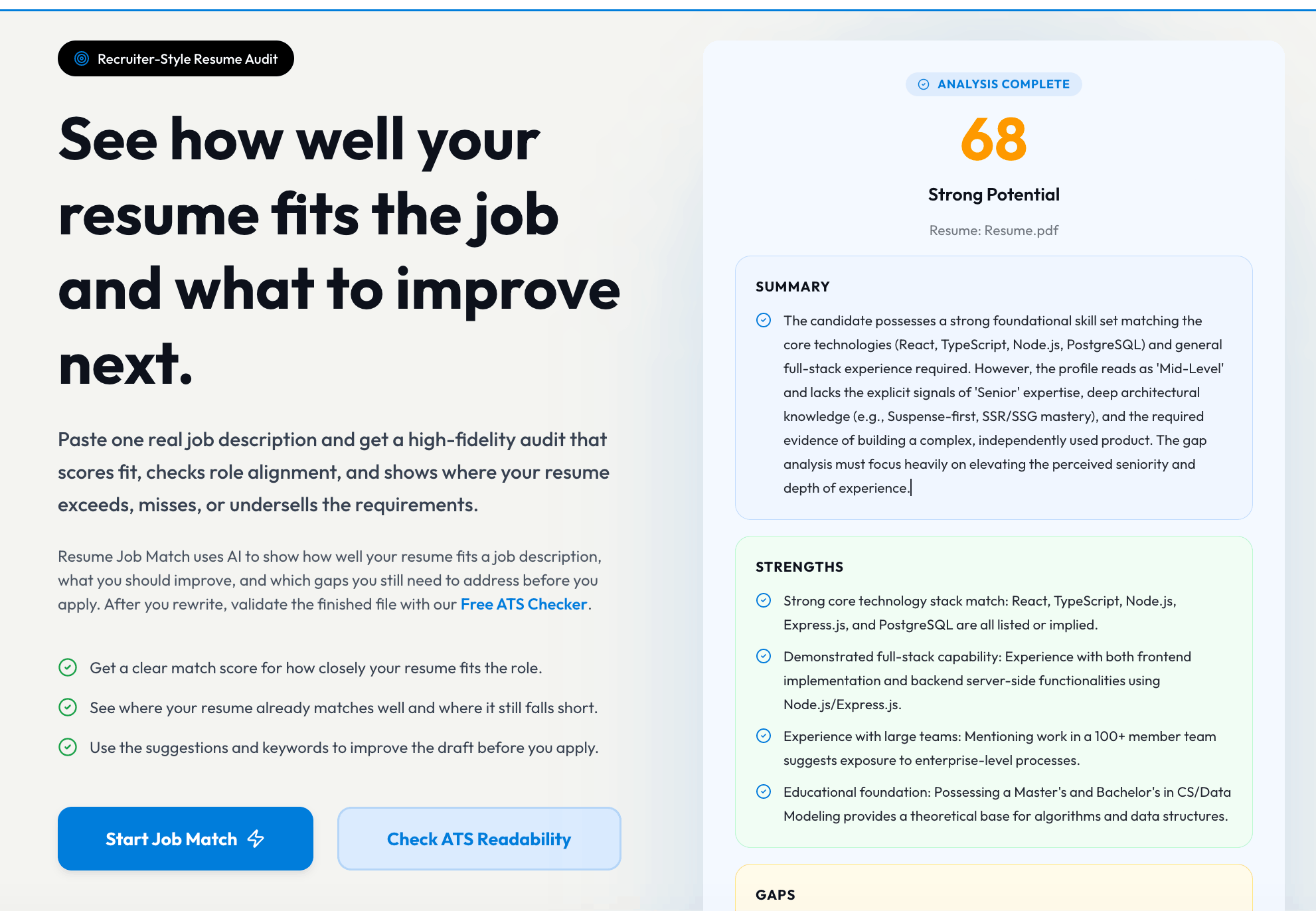
Use Resume Job Match to create the first comparison and Resume Skills Check to find skills that are present but buried or unsupported.
Step 4: Give AI a Fact-Preservation Contract
The quality of the prompt matters less than the quality of the evidence and constraints.
Start every tailoring request with rules like these:
You are editing a resume, not inventing one.

Use only facts in the verified evidence below.
Do not create employers, titles, dates, tools, credentials, metrics,
team sizes, budgets, customers, or outcomes.
Do not promote participation into ownership.
Do not copy sentences from the job description.
If a requirement has no evidence, label it GAP.
If evidence is adjacent, label the draft BRIDGE for review.
Keep the candidate's direct, plainspoken voice.
Return a change log showing which evidence ID supports each rewrite.
NIST's Generative AI Profile describes how generative systems can confidently produce false or internally inconsistent content. In a resume, even a small fabrication can create a background-check discrepancy or an interview claim you cannot defend. See the NIST Generative AI Profile.
Protect personal and confidential information
Before using any external AI service:
- remove street addresses and unnecessary personal identifiers
- exclude confidential employer, customer, patient, or financial data
- generalize sensitive internal metrics when policy requires it
- check the service's data controls and your employer obligations
- use placeholders for names when identity is irrelevant to the edit
AI needs enough context to edit the evidence. It rarely needs every private detail in the original document.
Step 5: Rewrite the Summary for This Job
A job-specific summary is a positioning statement. It should identify the target, establish relevant context, and preview the strongest evidence.
Use this structure:
Target role + relevant scope + domain or environment + two or three proven strengths
Generic summary
Results-oriented professional with excellent communication, leadership, and problem-solving skills. Proven ability to work independently and as part of a team.
The statement could describe almost anyone.
Tailored operations summary
Multi-site operations supervisor with 6 years coordinating schedules, inventory, vendors, and frontline teams across high-volume service locations. Known for reducing process delays, improving handoffs, and turning daily operating data into practical staffing and purchasing decisions.
Tailored customer success summary
Customer success specialist with 3 years onboarding B2B software customers, monitoring adoption signals, resolving escalations, and translating customer feedback for product and support teams. Experienced with Salesforce, HubSpot, and portfolio reporting for 45 active accounts.
Career-change summary: teacher to learning and development
Secondary-school educator transitioning into learning and development, with 7 years designing instruction, facilitating workshops, evaluating learner progress, and adapting materials for different ability levels. Built digital learning resources, trained new teachers, and used participation and assessment data to improve program delivery.
The career-change version names the transition once, then spends its space on evidence.
Summary rewrite prompt
Write three resume summaries of 45-65 words for the target role.
Use only evidence E-004, E-011, E-018, and E-027.

Version A: direct and conservative.
Version B: emphasizes domain experience.
Version C: emphasizes transferable skills for a career change.

For each version, list the evidence IDs used.
Do not use "results-driven," "passionate," "dynamic," or "proven track record."
Do not claim the target title as a past title.
Step 6: Rewrite Bullets Around the Employer's Work
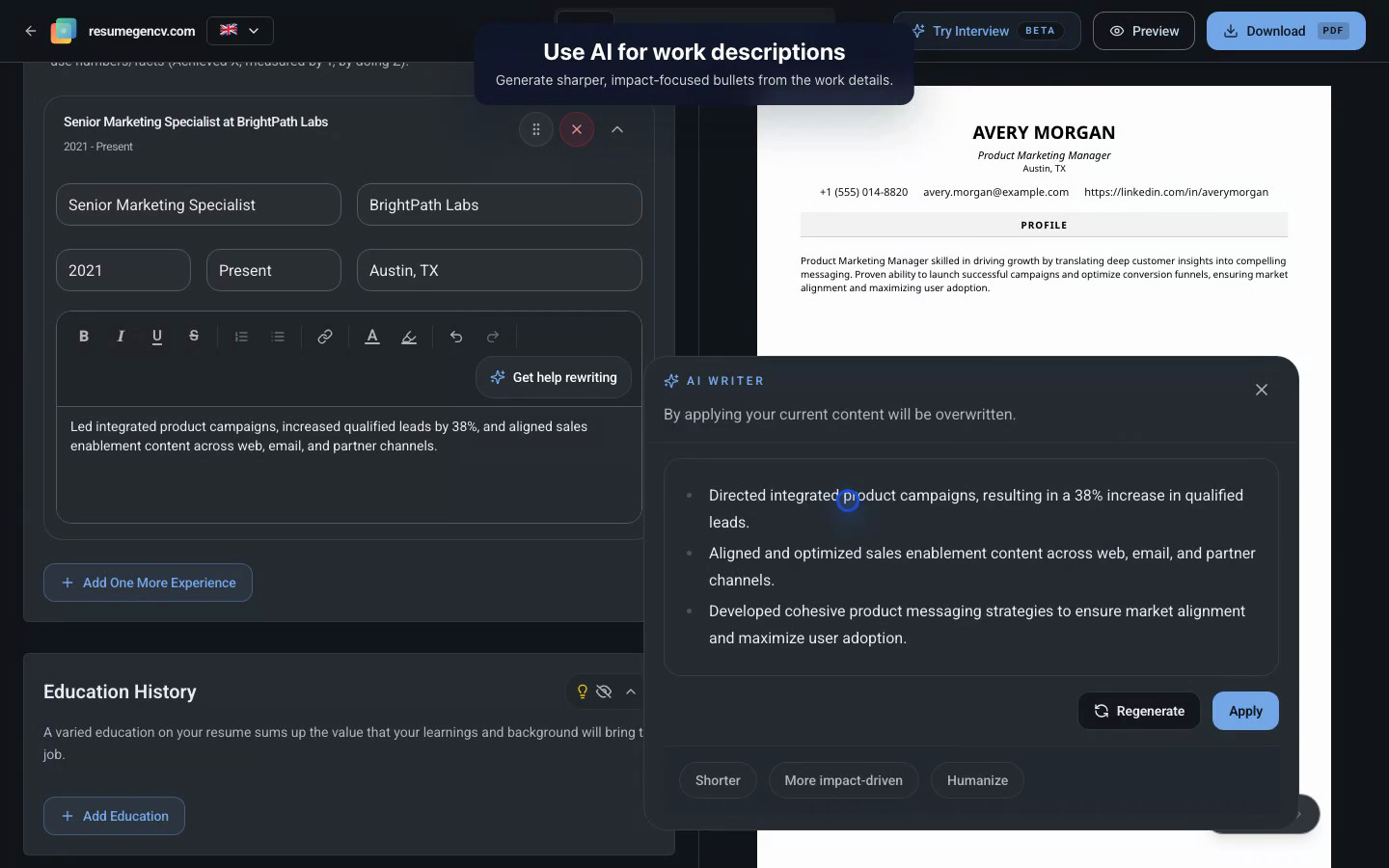
AI is most useful when it transforms verified notes into clearer evidence.
Use this bullet model:
Action + object + method or context + scope + outcome
Not every bullet needs all five elements. Every bullet should show more than a responsibility label.
Example: sales administration to revenue operations
Original:
Responsible for reports, Salesforce updates, and helping the sales team.
Verified facts:
- cleaned opportunity data for 14 representatives
- created weekly Excel pipeline report
- identified missing close dates and stages
- sales managers used report in forecast meeting
Tailored bullet:
Audited Salesforce opportunity data for 14 sales representatives and built a weekly Excel pipeline report that flagged missing stages and close dates before management forecast reviews.
The rewrite adds relevance without inventing a revenue outcome.
Example: restaurant manager to project coordinator
Original:
Managed a busy restaurant and handled staff and vendors.
Verified facts:
- coordinated opening of a new private-event space
- scheduled contractors and internal staff
- tracked equipment deliveries and inspection dates
- opened on planned date
Tailored bullet:
Coordinated the launch of a private-event space by tracking contractor work, equipment deliveries, staff readiness, and inspection dependencies; completed opening activities on the planned date.
The target language—launch, tracking, dependencies, readiness—describes the real work. It does not pretend the candidate held a formal project-management title.
Example: teacher to customer enablement
Original:
Taught classes and created lesson plans.
Verified facts:
- redesigned onboarding materials for new teachers
- facilitated six workshops
- created reusable guides and recorded demonstrations
- surveyed participants and revised confusing modules
Tailored bullet:
Designed and facilitated a six-session onboarding program for new teachers, combining live workshops, reusable guides, and recorded demonstrations; used participant feedback to revise low-clarity modules.
Bullet rewrite prompt
Target requirement: coordinate cross-functional launches and manage dependencies.

Rewrite the verified notes below into two resume bullets.
Maximum 32 words per bullet.
Lead with the action and keep the stated scope.
Use the target employer's vocabulary only when it accurately describes the work.
Do not add metrics or outcomes.

After each bullet, provide:
- supporting evidence IDs
- exact words changed for relevance
- any phrase that requires candidate verification
Transferable Skills: Translate the Work, Not Just the Trait
"Communication," "leadership," and "problem solving" are too broad to carry a career change. Transferable skills become credible when they are tied to a work pattern.
O*NET distinguishes skills and work activities that apply across occupations from occupation-specific information. Its current data includes explicit mappings of transferable skill ratings to occupations. See the O*NET Content Model and O*NET transferable skills data.
CareerOneStop's Skills Matcher similarly asks users to assess skills across areas and explore matching occupations. It is sponsored by the U.S. Department of Labor. See CareerOneStop Skills Matcher.
The five-part translation method
For each source-industry example, identify:
- Source action: What did you actually do?
- Underlying capability: What repeatable skill did it demonstrate?
- Target use: Where does the new role use that capability?
- Proof: What scope, outcome, tool, or artifact makes it believable?
- Bridge: What additional evidence reduces the industry or tool gap?
Career-change translation examples
| Source experience | Underlying capability | Target role | Resume translation | Useful bridge evidence |
|---|---|---|---|---|
| Teacher adapted lessons after assessment results | Learning analysis and content iteration | Learning designer | Revised learning modules using assessment and participation data | Authoring-tool project or instructional-design course |
| Restaurant manager opened event space | Dependency and launch coordination | Project coordinator | Tracked contractors, deliveries, inspections, and staff readiness | CAPM coursework or a documented project plan |
| Retail supervisor reviewed staffing and sales | Workforce and performance analysis | Operations analyst | Adjusted staffing using hourly traffic, sales, and service data | Excel dashboard or SQL fundamentals project |
| Journalist conducted source interviews | Qualitative research and synthesis | UX researcher | Planned interviews, identified themes, and translated findings into audience insights | Research plan, consent practice, portfolio case study |
| Military logistics specialist tracked equipment | Inventory control and risk management | Supply-chain coordinator | Reconciled assets, prioritized shortages, and coordinated time-sensitive movement | Civilian system terminology or relevant certification |
| Nurse trained staff on new clinical workflow | Adoption, facilitation, and domain expertise | Health-tech implementation | Trained clinical users, documented workflow issues, and escalated adoption risks | Product sandbox, implementation course, vendor credential |
These translations work because the source context remains visible. Removing the context entirely can make the claim look inflated.
Bridge Experience: The Missing Middle of a Career Change
Transferable skills explain why past work matters. Bridge experience shows that you have begun operating in the new context.
Useful bridges include:
- a project using a target tool
- coursework with a concrete output
- volunteering in the target function
- a stretch assignment inside the current job
- freelance or consulting work
- a certification with applied practice
- a portfolio case study
- professional association work
- job shadowing followed by a documented process analysis
Weak bridge
Completed project management course.
Stronger bridge
Built a launch plan for a simulated software rollout, including stakeholder map, work breakdown, dependency log, risk register, and weekly status template.
The stronger entry gives the recruiter artifacts and methods to evaluate.
Do not hide a gap with synonyms
If a target role requires SQL and you have used only Excel, "data analysis" does not erase the gap. State Excel accurately, show the analytical work, and add a SQL project if the transition is serious.
Use this language:
Direct: Excel reporting, PivotTables, Power Query
Developing: SQL coursework and customer-retention analysis project
Do not use this language:
Advanced data engineering and database expertise
Six Career-Change Bullet Examples
Hospitality to customer success
Before:
Helped guests and solved complaints.
After:
Resolved 25–35 guest issues per shift across booking, billing, and service workflows, documenting recurring causes and coordinating follow-up with front desk, housekeeping, and management teams.
Transfer: escalation management, customer communication, cross-functional resolution.
Retail to operations
Before:
Managed employees and inventory.
After:
Coordinated schedules, daily inventory controls, and opening procedures for a 14-person retail team, using traffic and sales patterns to adjust floor coverage during peak periods.
Transfer: staffing, operating cadence, resource allocation, data-informed decisions.
Teaching to learning design
Before:
Created engaging lessons for students.
After:
Designed 12-week blended-learning units with clear objectives, practice activities, assessments, and differentiated resources; revised modules using completion and assessment data from 90 learners.
Transfer: curriculum architecture, facilitation, evaluation, iteration.
Journalism to UX research
Before:
Interviewed people and wrote stories.
After:
Planned and conducted 20+ structured interviews for a public-service reporting series, coded recurring themes, validated conflicting accounts, and synthesized findings for nontechnical audiences.
Transfer: interview design, qualitative synthesis, evidence checking, communication.
Nursing to clinical implementation
Before:
Trained nurses on a new documentation process.
After:
Facilitated workflow training for 30 clinical staff during an electronic documentation rollout, captured adoption issues, updated quick-reference guidance, and escalated patient-safety concerns to the implementation lead.
Transfer: user adoption, change support, documentation, risk escalation.
Military logistics to supply chain
Before:
Responsible for equipment and transportation.
After:
Reconciled high-value equipment records, prioritized shortages, and coordinated time-sensitive movement across three operating locations while maintaining chain-of-custody documentation.
Transfer: inventory accuracy, prioritization, movement coordination, compliance.
Use AI as an Editable Workflow, Not a One-Click Generator
The scalable model has four layers.
Layer 1: Master profile
Contains complete history, evidence IDs, long-form notes, metrics, projects, skills, and interview stories. Update it when new work happens.
Layer 2: Role-family base resumes
Create a base version only when the target roles require meaningfully different evidence.
Examples:
- customer success / account management
- project coordination / operations
- content strategy / communications
- data analysis / business intelligence
Do not create separate bases for job titles that use nearly identical work.
Layer 3: Job-specific application copy
Duplicate the closest base, then tailor:
- headline and summary
- skills priority
- bullet selection and order
- relevant vocabulary
- projects and bridge evidence
- older-experience detail
Layer 4: Submission archive
Save the exact package sent:
2026-07-12_Acme_Project-Coordinator/
  Acme_Project-Coordinator_Resume.pdf
  Acme_Project-Coordinator_Resume.docx
  Acme_Project-Coordinator_Job-Description.pdf
  Acme_Project-Coordinator_Cover-Letter.pdf
  tailoring-notes.md
  application-record.txt
The archive matters when the interview arrives three weeks later. Prepare from the claims and emphasis the employer actually saw.
A Practical Version-Control System
You do not need developer tools to control resume versions. Use a clear naming convention and tracker.
| Field | Example |
|---|---|
| Application ID | 2026-0712-ACME-PC |
| Company | Acme Health |
| Role | Project Coordinator |
| Base resume | Operations v3 |
| Resume filename | Maya-Chen_Acme_Project-Coordinator.pdf |
| Changes | Summary B; bullets E-014, E-021, E-044; skills reordered |
| Gaps | No Jira; used Asana and Excel tracker |
| Submitted | July 12, 2026 |
| Status | Applied |
| Interview stories | Launch, vendor delay, process improvement |
Never overwrite the master profile with a tailored version. Never overwrite a submitted file after applying.
The Human Approval Pass
Review AI edits in this order.
1. Fact check
- Is every employer, title, date, tool, metric, and outcome correct?
- Did "supported" become "led"?
- Did a team size become a direct-report count?
- Did a percentage appear without a calculation?
2. Relevance check
- Does the top third point to this role?
- Are the strongest matching bullets early?
- Does bridge evidence appear where a gap would otherwise dominate?
3. Voice check
- Would you say this in an interview?
- Does it sound more inflated than the underlying work?
- Are there empty phrases that could describe any candidate?
4. ATS and readability check
- Are named tools and credentials written accurately?
- Does the document preserve a simple reading order?
- Can important evidence be found without decoding jargon?
Use the full ATS resume optimization guide for formatting and parsing checks.
5. Consistency check
Compare the tailored resume with:
- application form
- LinkedIn profile
- portfolio
- cover letter
- other recently submitted versions
Differences in emphasis are normal. Contradictory dates, titles, and claims are not.
Five Reusable AI Prompts
1. Job analysis prompt
Analyze this job description without rewriting my resume.
Return:
1. minimum conditions
2. five core responsibilities
3. desired business outcomes
4. named tools, methods, credentials, and domain terms
5. seniority signals
6. likely recruiter evidence
7. repeated or vague language

Quote only short phrases needed for classification.
Do not infer requirements that are not in the posting.
2. Evidence mapping prompt
Compare the role brief with my verified evidence ledger.
For each requirement, label it MATCH, BRIDGE, or GAP.
Name the evidence IDs that support the classification.
Do not treat a related tool as direct experience.
Do not draft resume text yet.
3. Bullet selection prompt
Select the eight strongest existing bullets for this role.
Rank them by relevance and evidence quality.
Explain why each earns space.
Identify repetitive bullets to remove.
Do not rewrite or add facts.
4. Constrained rewrite prompt
Rewrite only the selected bullets.
Keep every fact and scope unchanged.
Use plain language and target-role terminology where accurate.
Maximum 32 words each.
Return a support column containing evidence IDs and a change log.
Flag any sentence that needs verification.
5. Adversarial review prompt
Audit this tailored resume as a skeptical recruiter.
Find:
- unsupported claims
- title or date inconsistencies
- keywords with no evidence
- career-change leaps that need bridge proof
- generic summary language
- bullets that imply ownership not shown in the evidence
- missing must-have qualifications

Do not rewrite until the audit is complete.
What AI Should and Should Not Do
| AI can help with | AI should not decide |
|---|---|
| Classifying job requirements | Whether a claim is true |
| Finding buried relevant evidence | Whether an adjacent skill equals direct experience |
| Drafting multiple summary options | Which career history to conceal |
| Compressing notes into bullets | Whether to invent a metric |
| Suggesting transferable-skill language | Whether you can defend the translation |
| Comparing application versions | Whether sensitive data is safe to share |
| Flagging inconsistencies | Whether a legal or regulated qualification is satisfied |
The candidate owns the final document.
Quality Score for a Tailored Resume
This is an editorial self-audit, not an employer's private score.
| Category | Points | Full-credit standard |
|---|---|---|
| Job understanding | 20 | Role brief identifies core work, outcomes, tools, and minimum conditions |
| Evidence alignment | 25 | Priority requirements map to direct or clearly labeled bridge evidence |
| Summary and bullet quality | 20 | Writing is specific, concise, and supported by verified facts |
| Career-change credibility | 15 | Transferable skills retain source context and meaningful gaps have bridge evidence |
| Accuracy and consistency | 15 | Resume, profile, application, and archive agree on stable facts |
| Editability and version control | 5 | Master, base, and submitted versions remain separate and recoverable |
Interpretation:
- 90–100: ready for final formatting, proofreading, and submission
- 75–89: strong tailoring with a few evidence or clarity gaps
- 60–74: relevant language is present, but proof or focus is weak
- Below 60: return to the master profile and evidence map
Common Tailoring Mistakes
Generating from the job description alone
The model sees what the employer wants but not what you can prove. Add the master profile and evidence ledger first.
Changing every word to sound "more professional"
Excessive rewriting flattens your voice and makes bullets vague. Edit for relevance and clarity, not formality.
Treating transferable as identical
Coordinating restaurant vendors can support project-coordination potential. It does not automatically equal enterprise software implementation experience. State the transfer and add bridge evidence.
Using the target title as if you already held it
A headline can name the role you seek. Work-history titles must remain accurate.
Tailoring only the skills list
A keyword list does not prove fit. Put the most important skills inside evidence-based bullets.
Deleting all unrelated experience
Older or different work can show progression, reliability, leadership, or domain knowledge. Compress it when irrelevant; do not create unexplained gaps unnecessarily.
Forgetting what was submitted
If an interview answer contradicts the resume version in front of the recruiter, a good tailoring process has failed. Archive every final package.
Frequently Asked Questions
What does it mean to tailor a resume to a job description?
Tailoring means selecting and prioritizing truthful experience for one target role, using accurate language from the posting, and rewriting summaries and bullets so the most relevant evidence is easy to find. It does not mean inventing qualifications.
Can AI tailor my resume for each job?
AI can analyze a posting, suggest relevant evidence, and propose summary or bullet rewrites. You must verify every fact, reject unsupported additions, edit the voice, and save the exact version submitted.
Should I rewrite my whole resume for every application?
Usually no. Maintain a detailed master profile, then change the target title, summary, skills order, bullet selection, and emphasis for serious applications. Stable facts such as employers, dates, credentials, and verified results should remain consistent.
How do career changers show transferable skills?
Translate source-industry work into the underlying target capability, then prove it with context, scale, tools, and results. Add bridge evidence such as projects, coursework, volunteering, certifications, or adjacent responsibilities where direct experience is missing.
NACE's career-readiness framework is a useful shared vocabulary for broad competencies such as communication, critical thinking, teamwork, leadership, professionalism, and technology. Its definitions also emphasize observable behaviors rather than empty labels. See NACE Career Readiness.
Is it acceptable to change a job title for a tailored resume?
Do not replace an official title with a more senior or different role. If an internal title is unclear, add a truthful functional clarification in parentheses, such as Customer Hero (Customer Support Specialist).
How many tailored resume versions should I keep?
Keep one master profile, reusable base resumes for distinct role families, and one archived submission package for each application. The package should include the resume, job description, cover letter, application date, and notes.
Final Job-Specific Tailoring Checklist
Before submitting, confirm that:
- The master profile—not the job description—is the factual source of truth.
- The target posting was converted into a prioritized role brief.
- Each important requirement is labeled match, bridge, or gap.
- Every AI rewrite maps to verified evidence.
- No new title, tool, credential, metric, team size, or outcome appeared during rewriting.
- The summary names the target and previews relevant evidence.
- The strongest matching bullets appear early.
- Transferable skills retain enough source context to be credible.
- Meaningful career-change gaps have bridge evidence where possible.
- The skills section is supported by experience or projects.
- The resume remains readable and ATS-friendly.
- The application form, LinkedIn profile, and resume agree on stable facts.
- You can explain every tailored sentence in an interview.
- The exact submitted resume and job description were archived together.
The goal is not to make one resume sound perfect for every job. It is to create a reliable system that shows the right true evidence for each job—and lets you improve that system after every application.